




Royal Enfield’s 120-Year Survival Story and What It Says About Why We Ride
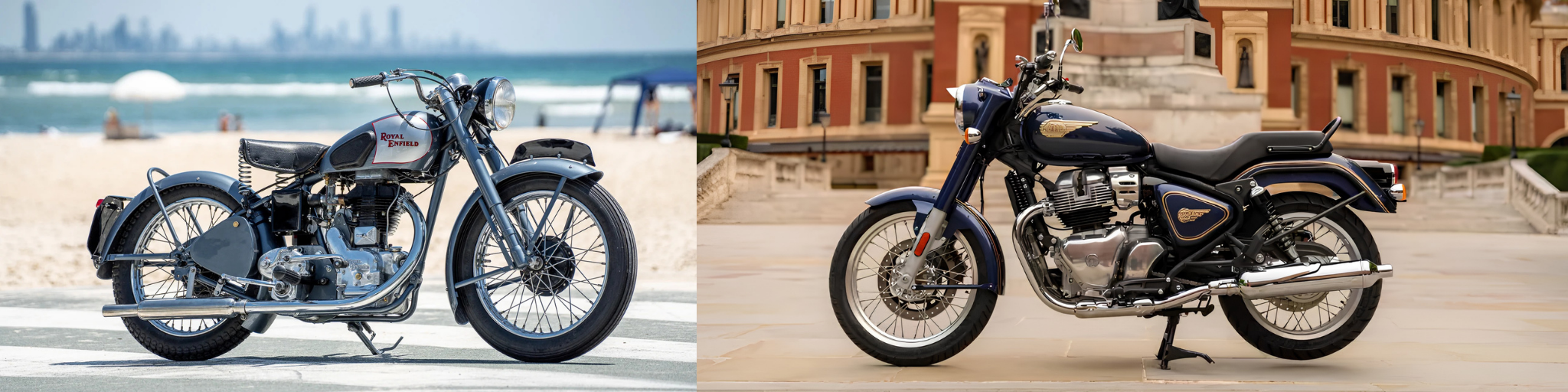
Table of Contents
- Summary
- The Paradox at the Center of This Story
- Redditch, 1901: Born in a Needle Town, Named After a Gun Factory
- The Bullet: The Longest-Running Motorcycle Design in History
- War Service and the Seeds of Survival
- How India Saved Royal Enfield
- The West Notices: The 650 Twins Change Everything
- What the Story Actually Says About Why We Ride
- Key Takeaways
- Frequently Asked Questions
- Come See the Bikes
- Continue Exploring
Summary
Royal Enfield is the oldest motorcycle brand in continuous production anywhere in the world. Founded in 1901 in Redditch, England, it outlasted every other pioneer of the early British motorcycle industry. Its parent company died. The Indian Army kept ordering its motorcycles. A subsidiary survived. A 650cc twin engine launched in 2018 shocked experienced riders who expected to dismiss it. The story of how a brand founded in a needle-making town survived 125 years without ever being the fastest, the biggest, or the most powerful says something important about what motorcycling is actually for.
Here is the question at the center of this story: how does a motorcycle brand survive 125 years without ever being the fastest, the most powerful, or the most technologically sophisticated machine in its class?
The answer is not what you might expect. Royal Enfield did not survive because of superior marketing, or a single charismatic leader, or a category-defining technological breakthrough. It survived because it kept building motorcycles that people actually wanted to ride. Not motorcycles that won specification wars. Motorcycles that fit the roads, the riders, and the reasons people got on them in the first place.
That story is worth knowing. Especially because the bikes it led to are sitting in our showroom right now.
The Paradox at the Center of This Story
Quick Answer: Royal Enfield has never been the fastest, the most powerful, or the most technologically advanced motorcycle in any era of its existence. It is, however, the oldest motorcycle brand still in continuous production in the world. Every other pioneer of the early motorcycle industry is gone. Royal Enfield is not. The question of how that happened is more interesting than any specification comparison.
The brands that competed with Royal Enfield in 1901 are almost entirely gone. Triumph, the other great British survivor, changed ownership so many times that its connection to the original company is largely historical. BSA, Velocette, AJS, Matchless, Norton – the legendary names of British motorcycling – are either gone or exist as trademark licenses on motorcycles built elsewhere.
Royal Enfield is different. The Bullet motorcycle that the Indian Army ordered in 1952 – the same basic design that was displayed at the Olympia Motorcycle Show in 1932 – was still being manufactured in 2026. That is not a restored classic or a heritage reissue. That is continuous, uninterrupted production of the same motorcycle design for over 90 years. It is the longest-running motorcycle design in history by a significant margin.
How this happened is not a story of winning. It is a story of surviving – which turns out to be more instructive.
Redditch, 1901: Born in a Needle Town, Named After a Gun Factory
Quick Answer: The Enfield Cycle Company was founded in Redditch, Worcestershire – a town historically famous for manufacturing sewing needles. The “Royal Enfield” name came from the company’s supply relationship with the Royal Small Arms Factory in Enfield, Middlesex. Their early motto – “Made Like A Gun, Goes Like A Bullet” – was not marketing copy. It was a literal description of their manufacturing heritage and became, inadvertently, a prophecy about the machine that would outlast everything else they built.
The origin story has a particular texture that is worth appreciating. Redditch was not a motorcycle town. It was a needle town – the center of the British sewing needle industry, full of precision manufacturing tradition but not especially romantic. The Enfield Cycle Company built bicycles and supplied precision parts to the Royal Small Arms Factory in Enfield, Middlesex, which made the rifles that went to the British military.
From that supply relationship came the name. From the firearms heritage came the motto: “Made Like A Gun, Goes Like A Bullet.” It was a quality claim before it was anything else. These are machines built to the same precision standards as military equipment. They will work when you need them to work.
The first Royal Enfield motorcycle appeared in 1901 – the same year as Indian Motorcycle, and two years before Harley-Davidson. It was a small machine with a 1.5 horsepower Minerva engine mounted at the front, driving the rear wheel through a leather belt. By modern standards it was primitive. By the standards of 1901, it was the beginning of something.
The founders – Bob Walker Smith and Albert Eadie – were not chasing the fastest machine or the largest engine. They were building something reliable. That priority, established in a needle factory in Worcestershire in 1901, turned out to be the through-line that kept the brand alive when everything else around it failed.
The Bullet: The Longest-Running Motorcycle Design in History
Quick Answer: The Royal Enfield Bullet was first displayed at the Olympia Motorcycle Show in London in 1932. It entered production and has been continuously manufactured, in updated but recognizable form, ever since. That is over 90 years of the same motorcycle design in continuous production – a record no other motorcycle in history comes close to matching.
The Bullet was not the most powerful motorcycle of its era when it launched. It was not the most technologically sophisticated. It was a well-engineered, reliable, single-cylinder machine with handling characteristics that worked on the roads of the 1930s – which in Britain and, more importantly, in India, meant unpaved, rough, demanding terrain that punished fragile machinery.
The single-cylinder thumper configuration – that distinctive exhaust pulse that Royal Enfield riders have always called “the thump” – was a byproduct of the engine architecture rather than a marketing decision. But it became something else over time: an identity. A sound so specific and so consistently maintained across 90 years of production that Bullet riders anywhere in the world can recognize another Bullet by sound alone before they see it.
What Made the Bullet Survive While Others Did Not
Other British motorcycles of the same era were faster, more powerful, and in many cases better reviewed in the contemporary press. They are not in production today. The Bullet is, for two connected reasons:
- It was simple enough to be maintained by riders with basic mechanical skills, without specialized tooling or access to a dealer network. In India, where it would prove most important, this was not a feature – it was a survival requirement.
- It was durable enough to work in conditions that more sophisticated machines could not handle. The Indian Army’s Kashmir patrols, the Himalayan passes, the monsoon roads of rural India – the Bullet handled them when more complex motorcycles could not.
The Bullet was not the best motorcycle of its era by most measurements. It was the right motorcycle for the conditions that mattered most. That distinction, maintained over 90 years of continuous production, is what the word “classic” actually means when it means something.
War Service and the Seeds of Survival
Quick Answer: Royal Enfield supplied motorcycles to the Allied forces in World War II – including a remarkable folding motorcycle designed for deployment by parachute. Unlike Indian Motorcycle, whose wartime commitment damaged its postwar civilian standing, Royal Enfield’s war production cemented its reputation for durability and military-grade reliability. That reputation followed the brand directly into its most important postwar relationship: the Indian Army.
Royal Enfield’s contribution to World War II included the WD/RE – a lightweight 125cc motorcycle designed to fold into a container small enough to be dropped by parachute with paratroopers. It was a remarkable piece of engineering for its era, and it demonstrated a principle that would define Royal Enfield’s survival: build what is actually useful for the conditions people are operating in, not what is impressive in a showroom.
The postwar period in Britain was difficult for motorcycle manufacturers. Consumer tastes were changing. American cars were arriving. The motorcycle’s role in daily transportation was being displaced. The British industry, which had once dominated global motorcycle production, began a long contraction.
Royal Enfield navigated this period better than most, but the real salvation did not come from Britain. It came from the east – from a newly independent country that needed motorcycles for its military and had a road network that made durability more important than speed.
How India Saved Royal Enfield
Quick Answer: In 1949, K.R. Sundaram Iyer began importing Royal Enfield motorcycles to India through Madras Motors. The Indian Army ordered 800 Bullets in 1952 for border patrol in Kashmir and Rajasthan. In 1955, Enfield India was formed as a manufacturing partnership. When the English parent company wound down operations by the late 1960s, the Indian subsidiary kept manufacturing. The brand that died in England lived on in India – and eventually grew into one of the largest motorcycle manufacturers in the world.
The Indian Army’s interest in the Bullet was not sentimental. It was practical. India had just achieved independence in 1947 and had a long, demanding border to patrol – including the high-altitude terrain of Kashmir and Rajasthan where road conditions were brutal and mechanical complexity was a liability rather than an asset.
The Bullet was ideal. It was simple. It was durable. It could be maintained by soldiers without specialized equipment. It worked at altitude where more sensitive engines struggled. The Army ordered 800 units in 1952 and they arrived from Redditch in 1953. What followed was not just a supply relationship – it was the beginning of a manufacturing partnership that would outlast the original manufacturer.
Enfield India Takes Over
In 1955, the Redditch company and Madras Motors formed Enfield India, with a new factory built near Madras (now Chennai). Initially, motorcycles were shipped from England in kit form and assembled in India. By 1957, Enfield India had the tooling to manufacture components from scratch. The dependency on England was reversing.
Through the 1960s, as the British motorcycle industry contracted around it, the Redditch factory’s production wound down. The original company’s remaining business was absorbed by Norton Villiers in 1967 and eventually closed entirely by the early 1970s. The English Royal Enfield was gone.
Enfield India kept making motorcycles. The brand that had died in its country of origin was alive and growing in the country that had needed its most useful product most urgently.
Eicher Motors and the Modern Era
In 1990, Eicher Motors – an Indian automotive conglomerate – acquired a controlling interest in Enfield India. By 1994, Eicher had full ownership. The company was renamed Royal Enfield and a deliberate transformation began: from a utilitarian workhorse brand to a premium motorcycle manufacturer serving riders who valued character, accessibility, and the pure experience of riding over maximum performance.
India’s growing middle class was buying motorcycles in the millions. Royal Enfield positioned itself above the mass-market commuter brands and below the expensive European imports – and found a market that was genuinely enormous. The Bullet, the Classic, the Thunderbird, and eventually the Himalayan established Royal Enfield as a brand with genuine identity in a market where most competitors offered transportation without character.
The West Notices: The 650 Twins Change Everything
Quick Answer: The Royal Enfield Interceptor 650 and Continental GT 650 launched in 2018. The response from Western motorcycle press and riders was immediate and largely surprised: these were genuinely well-made, genuinely enjoyable motorcycles at a price point that made experienced riders stop and reconsider what they thought they knew about the brand. The 650 twins are still regularly cited as among the best value propositions in motorcycling.
Royal Enfield had been selling in Western markets for decades, largely to enthusiasts of classic British style. The Bullet and Classic 350 had a following, but it was a niche following – people who wanted the look and the thump, who understood and accepted the trade-offs. The brand’s premium ambitions in India had not fully translated into credibility with experienced Western riders.
Then the 650 twins arrived.
The Interceptor 650 and Continental GT 650 shared a new parallel-twin engine that reviewers consistently praised for its smoothness, its character, and its engagement at legal road speeds. These were not bikes that demanded triple-digit speeds to feel rewarding. They were bikes that were genuinely fun on the roads most people actually ride.
What Surprised Experienced Riders
- Build quality that matched or exceeded their expectations for the price point
- Handling that was composed and balanced – not the wallowy quality some had assumed from the brand’s utilitarian reputation
- An engine character – not just power – that made riding genuinely engaging at everyday speeds
- A price that made the question “is it worth it” feel like the wrong question
The riders who came to the 650 twins expecting to be impressed by a budget brand and left instead genuinely enthusiastic about the ride created a word-of-mouth reputation that no marketing campaign could have purchased. Royal Enfield had done what it had always done: built a motorcycle that fit the actual experience of riding better than its price suggested it should. The Western market finally noticed.
What the Story Actually Says About Why We Ride
Quick Answer: Royal Enfield survived 125 years without ever winning the horsepower race, the technology race, or the prestige race. It survived by building motorcycles that served the actual reasons people ride – the experience, the character, the accessible joy of two wheels on a road – better than the alternatives. That is not a consolation prize. It is, arguably, the point.
If you ask riders why they ride – really ask, past the first answer – the answers almost never include horsepower numbers, top speeds, or technology features. They include freedom. Character. The feeling of being in the world rather than observing it. The particular attention that two wheels demands and the particular reward that attention creates.
Royal Enfield never won the specification wars because it never tried to. It competed on a different axis entirely: how does it feel to ride this motorcycle on the roads where most people actually ride? Is it enjoyable at legal speeds? Does it have character beyond its performance numbers? Does it connect the rider to the experience of riding rather than demanding maximum skill to access its capabilities?
The riders who love Royal Enfield motorcycles – and they are numerous, and they span every continent – do not love them despite their modest power output. They love them because the modest power output is part of what makes the riding experience what it is. A motorcycle you can fully explore on a public road is a different kind of enjoyable than one that reserves its character for speeds that require a track day to experience safely.
The brand that survived 125 years by building motorcycles for real riding rather than spec-sheet comparison has, in its survival, proven something about what motorcycling is actually for. Not every rider will reach the same conclusion. But the ones who sit on an Interceptor 650 and come back saying they did not expect to feel this way – those riders have understood something that the Royal Enfield story has been saying since 1901.
Key Takeaways
✔ Royal Enfield is the oldest motorcycle brand in continuous production in the world – founded in 1901 in Redditch, England
✔ The Royal Enfield Bullet, first displayed in 1932, is the longest-running motorcycle design in history
✔ The English parent company wound down in the late 1960s – the Indian subsidiary kept manufacturing and eventually became the primary Royal Enfield
✔ The Indian Army’s orders in the 1950s saved the brand – the Bullet was ideal for Kashmir border patrols because it was durable and simple enough to maintain in the field
✔ The 650 twin engine launched in 2018 changed Western riders’ perception of the brand – the Interceptor and Continental GT are consistently praised for their character and value
✔ Royal Enfield survived 125 years not by winning specification wars but by building motorcycles that served the actual reasons people ride
Every other motorcycle company from 1901 is gone. Royal Enfield is not. The reason why says something about what motorcycling is for.
Frequently Asked Questions
Is Royal Enfield still a British brand?
Technically no – and technically yes. The original Enfield Cycle Company that produced motorcycles in Redditch, England closed operations by the early 1970s. The brand and its manufacturing rights passed to Enfield India, which became Royal Enfield under Eicher Motors ownership. Today the company is an Indian manufacturer headquartered in Chennai. The British heritage is genuine and acknowledged by the company; the current operations are entirely Indian. It is one of the more genuinely international brand histories in motorcycling.
Is the Royal Enfield Bullet really still in production?
Yes. The Bullet 350 has been in continuous production since its launch in 1932 – making it the longest-running motorcycle design in history. It has been updated and refined over the decades but remains recognizably the same motorcycle. Royal Enfield sells it today alongside their more modern 650cc twin lineup. Buying a current Bullet connects you to an unbroken manufacturing lineage that predates most technology in your home.
Are Royal Enfield motorcycles good for experienced riders?
The answer changed significantly with the 2018 launch of the 650 twins. Experienced riders who have ridden the Interceptor 650 and Continental GT 650 consistently describe being more impressed than expected – by the engine character, the handling quality, and the genuine enjoyment at legal road speeds. These are not entry-level bikes dressed up to look appealing. They are motorcycles that experienced riders choose for the quality of the riding experience, not as a stepping stone to something else.
How does Royal Enfield compare to BMW or Indian in terms of quality?
Different categories with different strengths. BMW Motorrad offers the deepest technology ecosystem and the most sophisticated electronics for riders who want or need those capabilities. Indian delivers American touring and cruiser character with modern performance. Royal Enfield offers accessible, character-rich motorcycles at a price point significantly below the other two. The comparison is not really BMW vs. Indian vs. Royal Enfield – it is which brand fits how you actually ride and what you value in that experience. Come in and sit on all three. The answer will reveal itself.
Which Royal Enfield model is right for a first-time premium motorcycle buyer?
The Meteor 350 for riders who prioritize manageability and accessibility. The Interceptor 650 for riders who want more performance while keeping the accessible character that defines the brand. The Himalayan for riders with any off-pavement ambitions. All three are available to sit on and discuss at the showroom – and the conversation about which fits your riding is one we genuinely enjoy having.
Come See the Bikes
The Interceptor 650, Continental GT 650, Meteor 350, and Himalayan are in the showroom. The history behind them is interesting. The motorcycles themselves are worth sitting on. Come in and do both.
Browse Royal Enfield Inventory
Woodlands Premium Motorcycles | 198 Ed English Dr., Shenandoah, TX | Tuesday through Saturday
Call (936) 271-7600 or text (936) 271-7600 or (713) 804-4696
Continue Exploring
- The Indian Motorcycle Story: America’s First Brand and the Comeback Nobody Expected
- Why Experienced Riders Choose BMW, Indian, or Royal Enfield
- Who Actually Rides: What the Motorcycle Community Really Looks Like
- How to Choose Your Next Motorcycle (When You’ve Already Had a Few)
- The Benefits of Buying a Pre-Owned Motorcycle