



Who Actually Rides: What the Motorcycle Community Really Looks Like
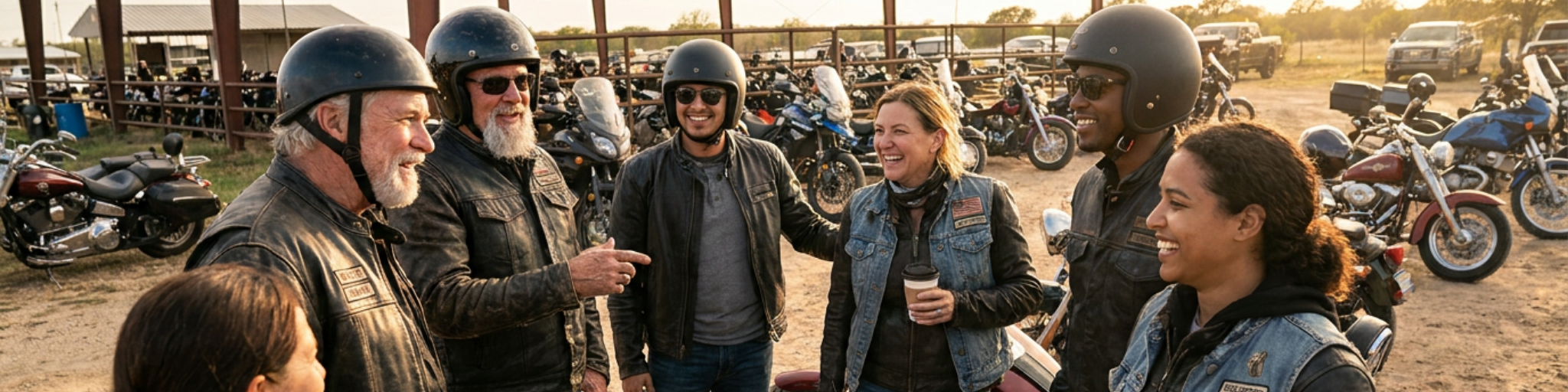
Image created with the assistance of AI.
Table of Contents
- Summary
- The Gap Between the Stereotype and the Reality
- Bessie Stringfield Rode Across America in 1930
- The East Bay Dragons and the History of Black Motorcycle Culture
- Women in Motorcycling: Always There, Never Optional
- What the Riding Community Looks Like in North Houston
- The Wave Is Not Accidental
- Key Takeaways
- Frequently Asked Questions
- You Belong Here
- Continue Exploring
Summary
Motorcycle culture has always been more diverse than its dominant image suggests. The history of who has actually ridden motorcycles – from the very beginning of the sport through today – includes Black riders who crossed America under Jim Crow, women who rode when society said they could not, Latino riders who built generational communities around two wheels, and everyone in between. That history is not a footnote to motorcycling. It is motorcycling. At Woodlands Premium Motorcycles, it is also who walks through our door.
If you built an image of the typical motorcycle rider from the most common marketing images in the industry, you would get a picture that does not look like the riding community we know.
It would not look like Bessie Stringfield, who crossed the United States solo on a motorcycle eight times starting in 1930, during Jim Crow, before interstate highways existed. It would not look like Tobie Gene Levingston, who founded America’s first all-Black motorcycle club in 1959 because the existing clubs would not have him. It would not look like the hundreds of women who were riding before anyone bothered to market motorcycles to them.
The real history of motorcycling is not the history of any one image. It is broader, older, and more interesting than that. Here is what the riding community actually looks like – always has, and increasingly does.
The Gap Between the Stereotype and the Reality
Quick Answer: The dominant image of the motorcycle rider – white, male, middle-aged, wearing leather – is a real demographic subset but not the whole picture. Women are among the fastest-growing segments of new motorcycle riders. The Black motorcycle club tradition is decades old. Latino riding culture has deep roots in Texas specifically. The “typical” rider is a composite that describes a portion of the community, not its character.
Stereotypes about who rides motorcycles tend to reflect who got photographed for motorcycle marketing, not who was actually on the roads. Those are different populations with different histories.
The Motorcycle Industry Council tracks rider demographics across the United States. Their data consistently shows a riding community that is more diverse in age, gender, and background than the category’s dominant marketing image suggests. Women represent a growing share of new riders. The median age of riders skews toward middle age but includes meaningful participation from riders in their 20s and their 60s. Economically, riders span every income bracket – the premium market and the first-bike market often overlap within the same family.
The gap between who the marketing shows and who actually rides is not an accident of the data. It is a reflection of which riders the industry chose to talk to for most of its history – and which riders rode anyway, regardless of whether the industry was paying attention.
Bessie Stringfield Rode Across America in 1930
Quick Answer: In 1930, Bessie Stringfield became the first African American woman to ride a motorcycle solo across all 48 contiguous states. She did this in the era of Jim Crow laws, before interstate highways, before most rural roads were paved, using The Negro Motorist Green Book to find safe places to eat and sleep. She went on to make that solo crossing eight times. The AMA inducted her into the Motorcycle Hall of Fame in 2002.
Bessie Stringfield was born in 1911 in Jamaica and raised in Boston after being orphaned at age five. She was given her first motorcycle – a 1928 Indian Scout – as a teenager, taught herself to ride it, and did not stop riding for the rest of her life.
At 19, she flipped a penny onto a map of the United States, pointed the bike toward where it landed, and started riding. By 1930, she had crossed the country solo, visiting all 48 connected states – a feat that would be notable for any rider in any era. In 1930, before the interstate highway system, before the Civil Rights Act, for a Black woman alone on a motorcycle, it was something else entirely.
She was regularly denied hotel accommodations and forced to sleep on her motorcycle at gas stations. She used the Green Book – the guide that allowed Black Americans to travel safely during segregation by identifying businesses that would serve them – to plan her routes. She encountered violence on the road. She kept riding.
During World War II, Stringfield served as a civilian motorcycle dispatch rider for the US Army, carrying documents between domestic military bases. She was the only woman in her unit. She later became a nurse in Miami, where police initially refused to issue her a motorcycle license because they did not believe a Black woman should be riding through the city. She demanded a meeting with the police chief – who happened to be a white motorcycle officer – and received her license.
Stringfield made her cross-country solo journey eight times total. She owned 27 Harley-Davidsons over her lifetime. She died in 1993. The AMA inducted her into the Motorcycle Hall of Fame in 2002. Her first motorcycle was an Indian Scout. She rode because the road was hers regardless of what anyone else thought about it.
The East Bay Dragons and the History of Black Motorcycle Culture
Quick Answer: The East Bay Dragons Motorcycle Club, founded in Oakland, California in 1959 by Tobie Gene Levingston, is America’s first all-Black motorcycle club. Levingston founded it because the existing motorcycle clubs would not accept Black members. The Dragons became a cornerstone of Oakland’s community – running charity rides, family events, and serving as what a 2014 Oakland City Council proclamation called “a symbol of positive community activism and pride.”
Tobie Gene Levingston arrived in Oakland from Louisiana in 1955, the son of a sharecropper. He loved motorcycles – specifically Harley-Davidsons – and wanted to be part of the motorcycle club culture that was taking shape in postwar California.
The clubs did not want him. In the 1950s, the motorcycle clubs that existed in northern California did not accept Black members. So Levingston, with his brothers and friends from East Oakland, started their own. They began as a car club in the mid-1950s. By 1959, they had switched to motorcycles – partly for practical reasons and partly because, as members recalled, a Black man on a Harley was a statement that felt worth making.
Levingston and the Dragons developed an unlikely friendship with Sonny Barger and the Hells Angels, who occupied the same East Oakland neighborhood. The relationship was based on the mutual recognition that they were all bikers, which – in that era and that place – was a more meaningful shared identity than the differences between them. Both clubs had a common adversary in local police harassment, and both understood the particular freedom that two wheels represented in a world with a lot of walls.
The Dragons survived the crack epidemic of the 1980s by enforcing a strict no-drugs policy and functioning, in Levingston’s words, as a place to “keep your mind occupied.” They ran turkey giveaways, family events, and charity rides. They built something that lasted more than 65 years.
In 2014, the Oakland City Council recognized the East Bay Dragons with a proclamation noting that the club had “remained a symbol of positive community activism and pride within Oakland and within the African American community.” Levingston died in July 2020. The club continues under new leadership. Their story is not a parallel to motorcycle culture. It is part of motorcycle culture.
Women in Motorcycling: Always There, Never Optional
Quick Answer: Women have been riding motorcycles since the beginning of the sport. Effie Hotchkiss crossed the continent on a Harley-Davidson sidecar in 1915. The Motor Maids, founded in 1940, is the oldest continuously operating women’s motorcycle organization in North America. Today, women represent the fastest-growing segment among new motorcycle buyers in the United States.
The idea that motorcycling is primarily a male pursuit is a marketing artifact, not a historical fact.
Women were on motorcycles within years of the motorcycle’s invention. Effie Hotchkiss and her mother crossed the United States on a Harley-Davidson motorcycle with a sidecar in 1915 – the same year Indian won a transcontinental record run. They completed the trip and returned the same way. In 1915, this was extraordinary. It was also something two women simply decided to do because they wanted to.
In 1940, Linda Dugeau and Dot Robinson founded the Motor Maids – a women’s motorcycle organization that required members to own and ride their own motorcycles (not ride as passengers), maintain a minimum annual mileage, and meet safety standards. The Motor Maids have operated continuously ever since, making them the oldest women’s motorcycle organization in North America.
Today, the trend line is clear. Women are consistently identified as the fastest-growing demographic among new motorcycle buyers. The growth is not driven by dealerships creating women’s programs – it is driven by women deciding to ride, the same way they always have.
At Woodlands Premium Motorcycles, we see this in our showroom and at our events. The question of which bikes work best for different body types and riding styles is a real conversation we have, not because women riders are different kinds of riders but because ergonomics are real and a bike that fits well changes the entire experience. The Royal Enfield lineup in particular – lower, lighter, with accessible seat heights – has been a natural fit for riders who want to start on a bike they can fully manage from day one.
What the Riding Community Looks Like in North Houston
Quick Answer: The Greater Houston area is one of the most diverse major metropolitan regions in the United States. That diversity shows up in who rides. The North Houston riding community includes riders from across the demographic range the industry sometimes forgets to talk to – and the routes, events, and culture of this area reflect all of them.
Houston is the most ethnically diverse major city in the United States. That is not a talking point – it is consistently documented and consistently reflected in the character of the city and the communities within it.
The North Houston and Woodlands area draws from that diversity. The riders who come through our door and who ride these roads represent a range of backgrounds that looks like the city they come from. Mexican American riders who learned on bikes their fathers rode. Nigerian American riders who discovered motorcycling through a colleague and never looked back. Women riders who started in their 40s and now log more annual miles than anyone in their riding group. Retired professionals on BMWs. Young riders on Royal Enfields learning the roads for the first time.
The Texas motorcycle club tradition – particularly in the Latino community – runs deep in this region. Clubs with decades of history in the Houston area have ridden these same FM roads, attended the same events, and built the same kinds of bonds that Levingston built with the Dragons in Oakland. That tradition is not separate from Houston motorcycle culture. It is Houston motorcycle culture.
We serve all of them. That is not a policy statement. It is a description of who actually walks through our door – and who we built the showroom, the staff, and the inventory to serve.
The Wave Is Not Accidental
Quick Answer: The motorcycle wave – the small acknowledgment riders give each other passing on the road – is one of the oldest traditions in motorcycling. It crosses every line that the rest of the world draws. It exists because riders have always recognized something in each other that has nothing to do with background, brand, or demographics: the shared experience of being on two wheels.
Nobody teaches you the wave. You give it the first time because someone gave it to you, and you realized you were part of something you did not know you had joined.
The wave has existed as long as motorcycles have existed in sufficient numbers for riders to pass each other on roads. It predates every marketing campaign, every club, every rivalry between brands and demographics. It exists because the experience of being on a motorcycle – the exposure, the attention required, the particular freedom of it – creates an immediate recognition between riders that cuts across everything else.
Bessie Stringfield exchanged that acknowledgment with other riders on unpaved roads in the Jim Crow South. Tobie Gene Levingston exchanged it with Sonny Barger in East Oakland. Riders on expensive European machines exchange it with riders on first bikes that cost a tenth as much. The wave does not care about any of the things that usually divide people.
That is not a romantic notion. It is an observable, consistent fact of motorcycle culture – one that has been true since there were enough motorcycles on the road for riders to pass each other. The community that has always existed around two wheels is not the community that any particular marketing campaign decided to show. It is the community that formed naturally, ride by ride, wave by wave, on every road this country has.
Key Takeaways
✔ The dominant image of the motorcycle rider reflects who got marketed to, not who actually rode
✔ Bessie Stringfield crossed the United States solo on a motorcycle eight times starting in 1930 – during Jim Crow, before interstate highways – and was inducted into the AMA Motorcycle Hall of Fame in 2002
✔ The East Bay Dragons, founded in Oakland in 1959, are America’s first all-Black motorcycle club – formed because the existing clubs excluded Black riders
✔ Women have been riding motorcycles since the sport began and represent the fastest-growing segment of new motorcycle buyers today
✔ Houston’s diversity shows up in its riding community – the North Houston riding culture reflects the full range of the city it rides out of
✔ The motorcycle wave is the oldest and most honest expression of what the riding community actually is
The riding community has always been bigger than its most common image. At Woodlands Premium Motorcycles, we know that because we see it every day.
Frequently Asked Questions
Are women motorcycle riders a new trend?
No. Women have been riding motorcycles since the earliest years of the sport. Effie Hotchkiss crossed the United States on a Harley-Davidson sidecar in 1915. The Motor Maids, the oldest women’s motorcycle organization in North America, have operated continuously since 1940. What is relatively new is the industry’s consistent attention to women riders in marketing – the riders themselves have been there all along.
Is motorcycling growing among diverse riders?
Yes – and the growth is consistent across multiple demographic groups. Women represent the fastest-growing category of new motorcycle buyers. Black and Latino riders have deep traditions in motorcycling that predate their recent visibility in mainstream motorcycle marketing. The riding community is not becoming diverse – it always was. It is becoming more visible.
What is the best motorcycle for a first-time rider from a non-traditional riding background?
The same thing it is for any first-time rider: a motorcycle that fits your body, matches your intended riding, and does not exceed your current skill level. The Royal Enfield lineup in particular offers lower seat heights, lighter weights, and manageable power that makes the first ownership period more accessible for riders of all backgrounds and experience levels. Come in and sit on a few bikes – the fit question answers itself quickly.
Are there motorcycle communities in the Houston area for riders from diverse backgrounds?
Many. The Houston metro area has one of the most active and varied motorcycle club and community scenes in Texas, reflecting the city’s demographic breadth. Our events bring riders from across that spectrum together regularly. If you are new to the area or new to riding, come to an event – it is the fastest way to find your people.
Does Woodlands Premium Motorcycles have resources for new riders who are not from a traditional riding background?
Yes. Our New Rider Program is built for riders who are starting from the beginning – regardless of background. We partner with Safety on Two Wheels for rider education, and our team can work with any rider to find the right platform, the right gear, and the right starting point. No experience required to walk in the door.
You Belong Here
Woodlands Premium Motorcycles is for every rider who wants to be here. New riders, experienced riders, riders coming back after time away, riders who have never seen someone who looks like them in a dealership before. Come in. The bikes do not care about any of that, and neither do we.
198 Ed English Dr., Shenandoah, TX | Tuesday through Saturday
Call (936) 271-7600 or text (936) 271-7600 or (713) 804-4696
Continue Exploring
- The Indian Motorcycle Story: America’s First Brand and the Comeback Nobody Expected
- The Real Cost of Motorcycle Ownership in Texas
- The Science Behind Motorcycle Riding: Why Your Brain Loves Being on Two Wheels
- Dropping Your Motorcycle: What New Riders Should Actually Know
- New Rider Program at Woodlands Premium Motorcycles